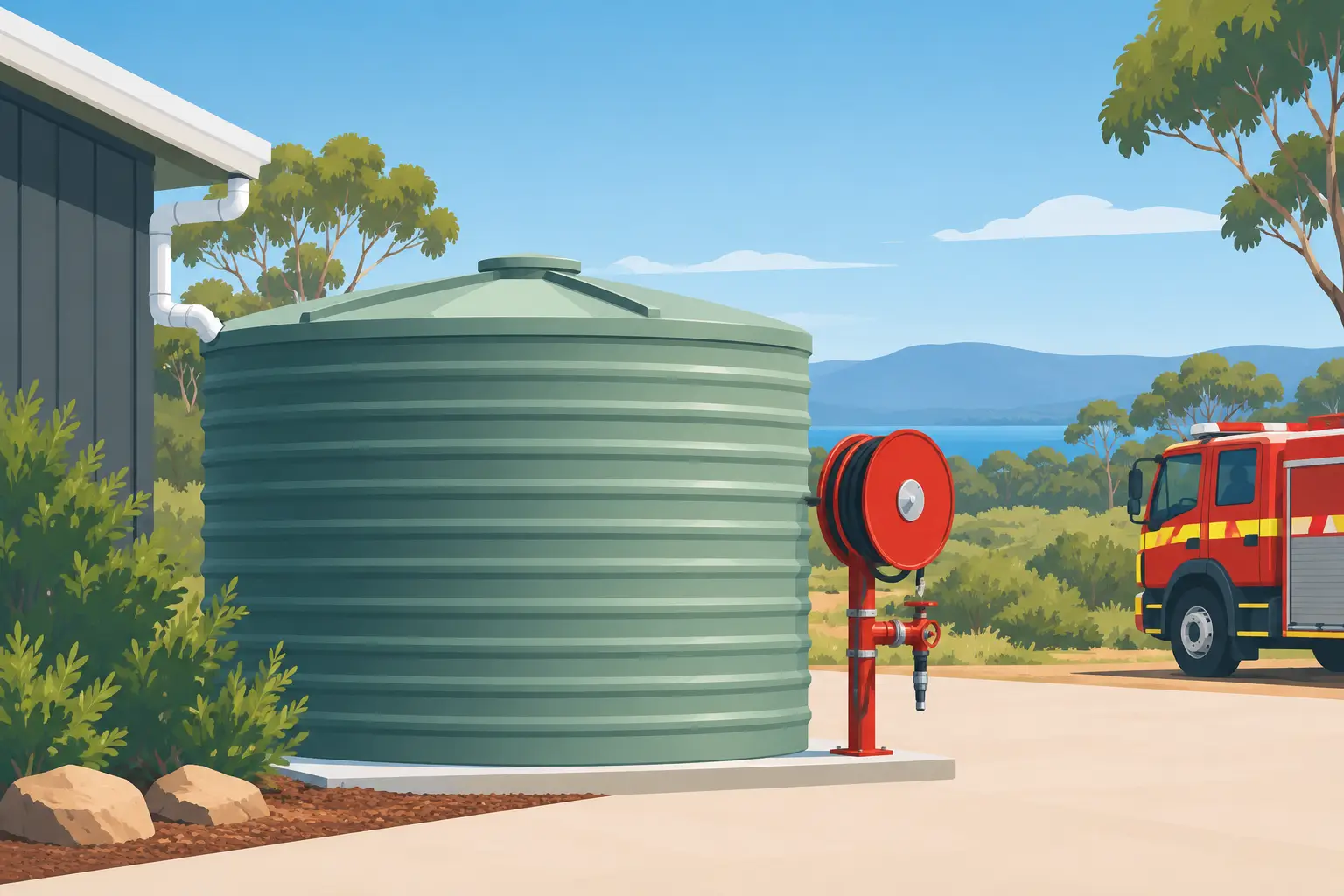
A water tank that keeps a household supplied through a dry spell may not automatically satisfy fire water storage requirements. For properties in bushfire-prone parts of Australia, the difference comes down to usable reserve volume, accessible fittings, pump performance and whether fire services can reach the water when conditions are at their worst.
For homeowners, rural families, builders and commercial property owners, the right answer is rarely just “buy a bigger tank”. Local planning conditions, the building class, the Bushfire Attack Level (BAL), driveway access and your fire authority’s expectations can all change what is required. Getting these details right during planning is far more cost-effective than altering a completed tank and pump installation later.
Why fire water storage is treated differently
Domestic rainwater storage is designed around everyday demand: drinking, washing, toilets, gardens and livestock. Fire water storage has a different job. It must remain available during an emergency, potentially when mains supply is disrupted, electricity is out and firefighters need to connect quickly.
That is why many approvals specify a dedicated firefighting reserve. A tank may physically hold 22,500 litres, for example, but only part of that volume may be credited for fire protection if the rest is available for household use. The nominated reserve needs to be maintained, clearly understood by everyone using the property and able to be drawn from through an appropriate outlet.
The exact volume varies considerably. Some developments may require a smaller static supply, while rural dwellings, subdivisions, larger buildings or high-risk sites can require substantially more. Do not rely on a neighbour’s setup or a general rule quoted online. Confirm the current requirement with your local council, certifier, planning consent, fire authority and insurer where relevant.
Fire water storage requirements: the key checks
A compliant system is about more than litres. The tank, location, access point and supply equipment need to work together. Your approved plans or conditions of consent should take priority, but these are the areas commonly assessed.
Required volume and protected reserve
Start with the approved firefighting water volume. Your tank capacity needs to cover that reserve as well as the water your household, business or livestock operation expects to use. Where one tank serves several purposes, a reserve arrangement may be needed so normal consumption cannot reduce water below the required level.
This can be managed through tank sizing, dedicated tanks, separate suction points or control arrangements, depending on the design. A practical approach is to allow enough additional capacity that the fire reserve does not make daily water use stressful during a dry period.
For rainwater systems, consider how quickly the tank refills after a low-rainfall season. A large roof catchment helps, but it does not replace sensible storage planning. If water security is critical, some properties also use a supplementary supply strategy, subject to local requirements.
Tank material, construction and location
Fire water tanks are commonly manufactured from poly, steel or concrete. Each can suit the job when correctly specified. Poly tanks are lightweight, corrosion-resistant and available in a wide range of capacities. Steel tanks can provide large-volume storage and suit sites where a durable liner-based system is preferred. Concrete may suit some established rural or commercial applications.
The best choice depends on capacity, vehicle access, site slope, available footprint, transport access and local conditions. For poly tanks, UV-stabilised construction matters in Australia’s harsh sunlight. For any tank, install it on a properly prepared base that supports the full operating weight. Water weighs roughly one kilogram per litre, so a full 22,500-litre tank places more than 22 tonnes on its foundation before allowing for the tank itself.
Positioning also matters. Fire appliances need a safe approach, turning space where required and a connection point that is not blocked by fencing, parked vehicles, vegetation or landscaping. Avoid placing the tank where heat, falling branches or inaccessible terrain could make it unusable in an emergency.
Fire brigade access and fittings
A tank that cannot be accessed quickly is not much help to a responding crew. Required fittings differ between jurisdictions and project types, but may include a dedicated outlet, a hard suction connection, compatible couplings, clear signage and all-weather vehicle access.
The fitting’s location, height and clearance are just as relevant as its size. It needs to be visible and reachable without moving obstacles or running hoses across unsafe ground. Some requirements also address the distance between the water point and a suitable appliance standing area.
Because connection standards are not universal, do not select firefighting fittings on assumption. Check the specification in your development approval and confirm it with the appropriate local authority before installation. This small step can prevent an expensive mismatch between the tank outlet and the equipment expected on site.
Pump, power and pipework
Not every fire water supply relies on a pump. Static water points may be designed for fire appliance drafting, while other setups include a dedicated firefighting pump or a household pressure pump arrangement. If a pump is part of the approved design, it must deliver the required flow and pressure through correctly sized pipework.
A standard household pump may be excellent for showers, taps and garden use but unsuitable for firefighting duty. Pump selection should account for suction lift, pipe diameter, pipe length, elevation change and the number of outlets that may operate at once. Undersized pipework can restrict performance even when the pump looks adequate on paper.
Power resilience deserves attention too. Bushfires can interrupt mains electricity. Depending on the property and requirements, this may mean a diesel-powered pump, an approved backup power arrangement or a static connection that does not depend on your own power supply. Protect pumps and exposed pipework from physical damage, while keeping controls and fittings accessible.
How bushfire planning changes the design
Bushfire-prone land often brings additional planning and construction considerations. Your BAL assessment helps determine the level of bushfire exposure used in building design, but it is not a stand-alone instruction for tank capacity. Water supply requirements can arise through planning conditions, bushfire management plans, building approvals or rural fire service guidance.
This is particularly relevant for new homes on acreage, farm buildings, holiday accommodation and properties accessed by narrow or steep private roads. A compliant fire water solution may need to be considered alongside driveway width, passing bays, property identification, defendable space and vegetation management.
If you are replacing an existing tank, do not assume the new installation can simply copy the old one. Older systems may not reflect current approval conditions, and changing capacity, location or fittings can affect compliance. Builders and owners should confirm requirements before ordering the tank, rather than after excavation or site preparation begins.
A practical buying and installation checklist
Before selecting a tank and pump package, gather the paperwork for your site. This includes planning conditions, building documentation, bushfire reports and any written advice from the relevant authority. Then verify the required water volume, reserve arrangement, fitting type, tank location and access standard.
Ask your supplier for the tank dimensions, full weight, inlet and outlet options, base requirements, material specifications and warranty details. If a pump is required, confirm its duty point rather than choosing only by horsepower or maximum pressure. A qualified plumber, pump technician or fire services professional can help match the components to the approved design.
It also pays to plan future servicing. Keep valves operable, strainers clean and connection points free of mud, weeds and stored equipment. Check water levels through dry weather, test the pump in line with the manufacturer’s guidance and replace damaged signs or fittings promptly. Fire water storage is only dependable when it remains ready year after year.
Make the system easy to use when it counts
The most reliable fire water setup is one that has been planned for the property, documented clearly and maintained without fuss. A correctly sized tank is a strong starting point, but usable access, compatible fittings and a protected reserve are what turn stored water into practical protection.
Aus Water Tanks can assist with tank, pump and accessory selection for a complete water storage setup, while final fire protection requirements should always be confirmed with the authorities responsible for your site. A little care at the design stage gives your household, builder or business greater confidence when water security matters most.