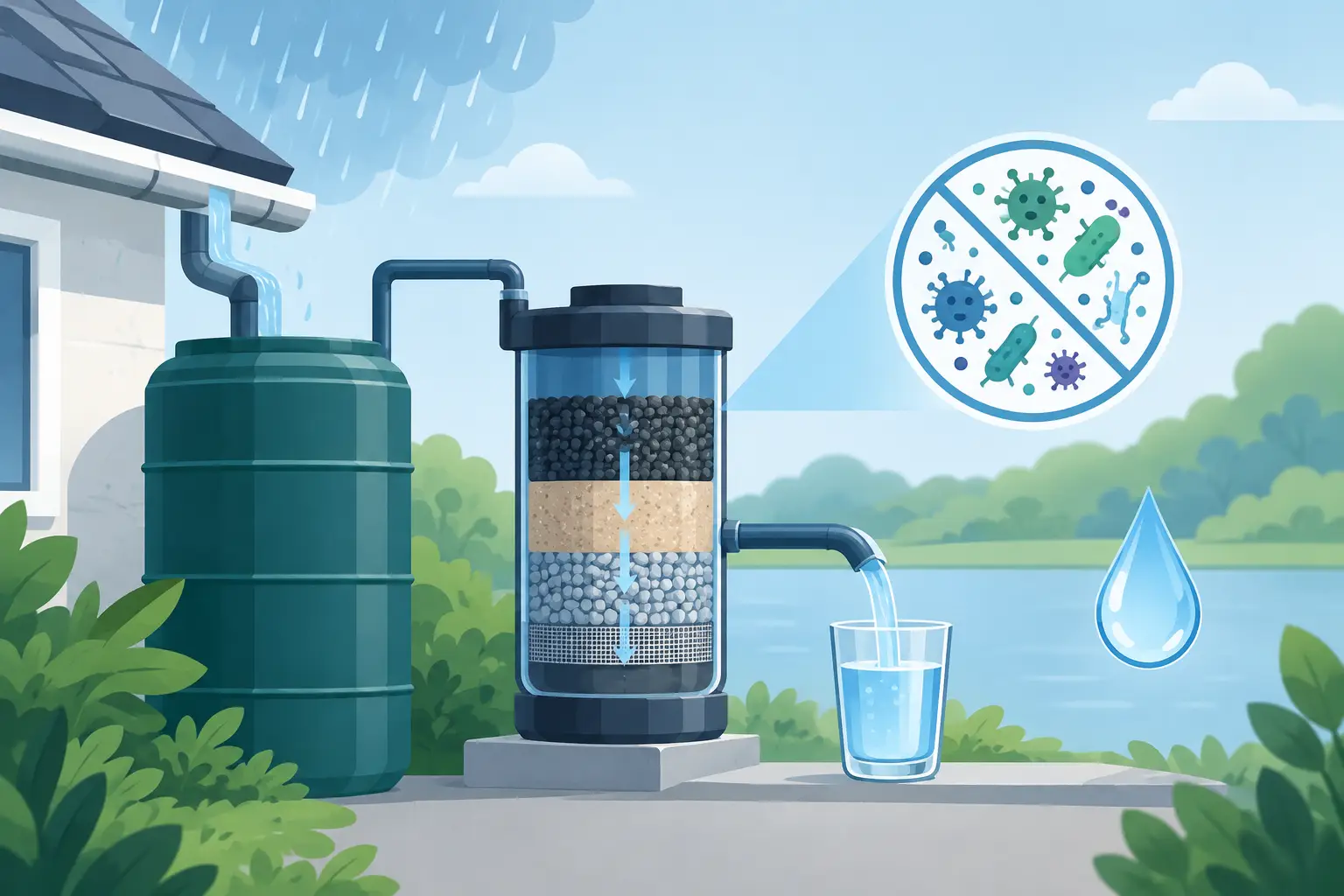
A clear-looking tank supply can still carry microorganisms from the roof, gutters, bird droppings, insects or small animals. So, can rainwater filters remove bacteria? Some specialised filters can physically reduce bacteria, but standard rainwater filters are not a reliable bacteria treatment on their own. For household drinking water, a properly sized UV disinfection unit is usually the practical final barrier – provided the water has been filtered first.
For families using rainwater throughout the home, the goal is not simply to make water look clean. It is to build a treatment system that protects water quality from the tank through to the tap, while remaining straightforward to service.
What ordinary rainwater filters actually remove
Most whole-house rainwater systems begin with sediment filtration. A sediment cartridge captures physical particles such as roof grit, dust, rust, fine sand, organic debris and sediment stirred up from the base of a tank. This improves water clarity, helps protect pumps and plumbing, and prevents the next treatment stage from becoming blocked too quickly.
Sediment filters are rated by micron size. As the micron rating gets smaller, the filter captures finer particles. A 20-micron cartridge is often used as an initial pre-filter, while a 5-micron cartridge is commonly used before UV disinfection. The right combination depends on the amount of sediment in the tank supply, the household flow rate and how regularly the system can be serviced.
However, a typical sediment cartridge should not be treated as a bacteria filter. Bacteria are far smaller than the particles these cartridges are designed to catch, and the performance of a cartridge can vary as it loads with sediment or water bypasses around an incorrectly fitted seal.
Activated carbon filters have a different job. They can improve taste and odour and reduce some organic compounds, but they are not a dependable disinfection method either. In a rainwater system, carbon is generally selected for water quality preferences after the basic sediment and microbiological treatment needs have been addressed.
Can rainwater filters remove bacteria by themselves?
A very fine membrane filter can remove or reduce certain bacteria by physical exclusion, but this approach has trade-offs. It requires suitable pressure, careful pre-filtration and frequent monitoring because fine membranes can block quickly when supplied with untreated roof water. It may be appropriate in a specialised setup, but it is not usually the simplest whole-house answer for a family rainwater supply.
Cartridge filters advertised with a small micron rating can also be misunderstood. A micron number alone does not prove that a filter will remove bacteria. The filter construction, its tested performance, whether the rating is nominal or absolute, water pressure and installation all matter. A nominal rating means a filter catches a proportion of particles around that size. An absolute rating indicates a much tighter performance claim, but it still needs to be assessed in the context of the system and the manufacturer’s specifications.
Most importantly, removing some bacteria is not the same as making water microbiologically safe. Rainwater can contain a changing mix of microorganisms, including bacteria, protozoa and viruses. A treatment system should be chosen for the risks that may be present, rather than relying on one filter to cover every possibility.
Why UV disinfection is the usual final step
UV water disinfection works by exposing microorganisms to ultraviolet light in a treatment chamber. When correctly sized and maintained, UV can deactivate bacteria and other microorganisms without adding chemicals or changing the taste of the water.
For many Australian households on tank water, a whole-house sequence of sediment filtration followed by UV is a sensible, reliable arrangement. The sediment filters remove the particles that make water cloudy. The UV unit then treats the clarified water before it enters the home’s plumbing.
Water clarity is critical. Sediment can shield microorganisms from UV light, which is why UV should not be installed as a standalone fix after a dirty tank. A UV unit also needs to match the actual peak flow rate of the home. Selecting a unit that is too small can mean water passes through faster than the unit is designed to treat it, particularly when several taps, showers or appliances are operating at once.
A well-designed UV system should include a suitable chamber, correctly matched lamp and control gear. Depending on the model and household requirements, features such as lamp-life indication, audible alarms or UV intensity monitoring can offer added peace of mind. The lamp may still glow after its effective output has declined, so replacing it at the manufacturer’s recommended interval is essential.
A practical rainwater treatment setup for the whole house
The best treatment begins before water reaches the filter housing. Keep roof catchments and gutters maintained, fit gutter guards where suitable, and ensure the tank inlet is protected with a quality leaf strainer or mosquito-proof screen. A first-flush diverter can also help keep the dirtiest initial roof runoff out of the tank.
Inside the tank, avoid drawing water from the sediment layer at the bottom. A floating outlet draws water from below the surface, where it is generally cleaner, and can reduce the load placed on filters. A calm inlet helps prevent settled material from being stirred up whenever fresh water enters.
After the pump, many homes use a staged filtration arrangement. A coarser sediment filter may be useful where water carries visible grit, followed by a finer cartridge that prepares the water for UV. The UV unit is then installed after filtration, with clean water delivered to household taps, showers, toilets and appliances.
There is no single cartridge combination that suits every property. A home with a clean roof, enclosed tank and low sediment load may need a simpler setup than a rural property with large roof catchment areas, frequent dust, overhanging trees or older plumbing. Water testing can help identify concerns and prevent spending money on treatment stages that do not match the actual water source.
Maintenance is part of the treatment
A filtration system only performs as well as its maintenance. Sediment cartridges need changing when they become loaded, when pressure drops, or at the scheduled service interval. Leaving a dirty cartridge in place for too long can reduce household flow and create conditions that are less hygienic than a properly maintained system.
UV lamps also need scheduled replacement, commonly annually, even if the lamp still appears to be working. The quartz sleeve around the lamp should be inspected and cleaned as required. Mineral scale, iron staining or film on the sleeve can reduce the amount of UV light reaching the water.
Tank maintenance matters just as much. Check inlet screens, gutters, overflows and tank lids, and remove accumulated sludge when necessary. If contamination is suspected – for example, after an animal has entered the tank, floodwater has affected the system, or water has an unusual smell or appearance – stop using the supply for drinking until the cause has been assessed and the system has been cleaned or disinfected appropriately.
When extra treatment may be worthwhile
UV and sediment filtration are often enough for a well-managed rainwater supply, but particular situations may call for another layer of protection. If there are concerns about dissolved contaminants, salinity, specific chemicals or drinking water quality at a single kitchen tap, reverse osmosis may be considered as a point-of-use option. It is not generally necessary to use reverse osmosis for every tap in the house, and it produces a separate drinking-water supply rather than replacing good tank and whole-house filtration practices.
For homes with young children, elderly residents or people with compromised immune systems, it is sensible to take a more cautious approach. Discuss the water source, household use and treatment requirements with a qualified water treatment specialist, and consider laboratory testing where there is any uncertainty.
The dependable approach is to protect the water at every stage: keep debris out of the tank, filter sediment before it reaches the home, use UV as the disinfection barrier, and service each component on time. That gives your household a practical system for cleaner rainwater and more confidence every time the tap is turned on.