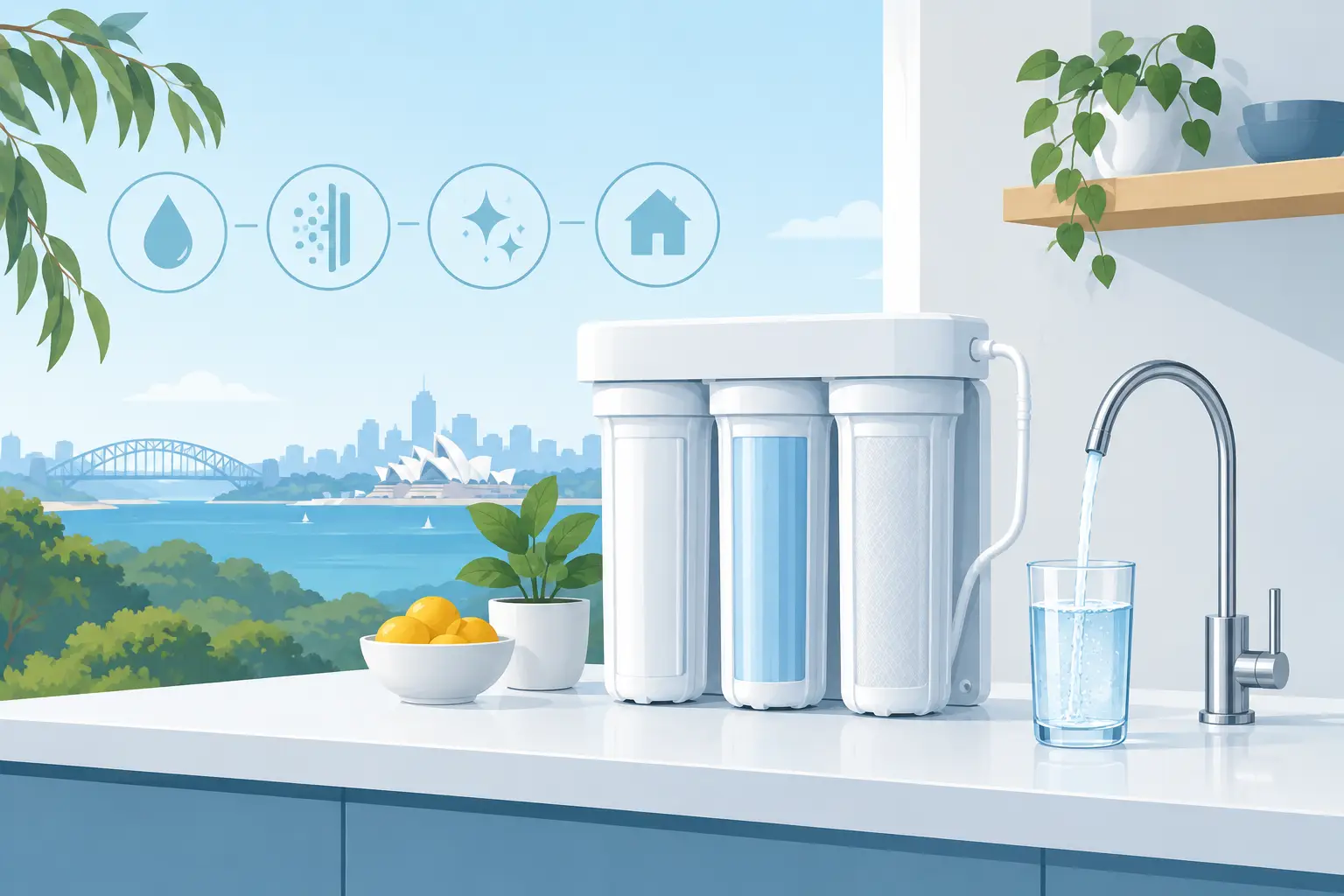
A clear glass of water can still carry the things homeowners want to manage: fine sediment from a rainwater tank, chlorine taste from mains supply, or microorganisms that cannot be seen at all. This home water treatment guide helps you choose a system based on your actual water source, household use and maintenance expectations – rather than buying filtration that sounds impressive but does not solve the problem.
For many Australian homes, the best answer is not one filter. It is a treatment sequence where each stage has a clear job: remove particles, improve taste and odour, or disinfect water before it reaches taps, showers and appliances.
Start with the water source, not the product
Rainwater and mains water create different treatment priorities. A whole house system should be matched to the supply entering your home, how water is stored or delivered, and whether you want filtered water at every tap or only for drinking.
Rainwater can be an excellent household supply when the collection system and treatment equipment are properly maintained. However, roof debris, dust, sediment, leaves, insect matter and organic material can enter a tank. Wildlife and bird droppings may also introduce microorganisms. Even water that looks clean may need suitable filtration and UV disinfection if it is used for drinking, food preparation, bathing and everyday household use.
Mains water has already been treated by the local supplier, but many households prefer to reduce chlorine or chloramine taste and odour. Sediment can also be an issue in some areas, particularly after supply works or where older pipework is present. A whole house mains water filter commonly uses sediment filtration followed by activated carbon, selected to suit the flow rate and the disinfectant used in the local supply.
If you are unsure what is in your water, start with the practical signs. Is there visible grit in tap water? Does it smell earthy after rain? Is chlorine noticeable in showers or cups of tea? Does water leave staining or scale? For a more complete picture, a laboratory water test can identify specific concerns and help avoid unnecessary treatment stages.
A home water treatment guide to the main technologies
The strongest systems use the right technology for a defined purpose. No single cartridge removes every contaminant, and each treatment method has limits.
Sediment filtration protects the rest of the system
Sediment filters capture physical particles such as sand, rust, dirt and fine debris. They are especially important for rainwater supplies, where a tank may collect material despite good roof catchment practices and inlet screens.
A sediment cartridge is commonly rated in microns. A lower micron rating catches finer particles, but it may also restrict flow sooner if the incoming water is dirty. This is why cartridge size, filter housing size and expected water use matter. A large family home with multiple bathrooms generally needs more flow capacity than a small cabin or a single-tap drinking water filter.
Sediment filtration is also essential before carbon filters and UV systems. It keeps carbon cartridges from blocking prematurely and helps UV light reach microorganisms without being shadowed by particles in the water.
Activated carbon improves taste and odour
Activated carbon is widely used for town water because it can reduce chlorine, unpleasant taste and odour. It may also improve the smell of rainwater where organic material has affected water quality.
Carbon filtration is not a substitute for UV disinfection on a rainwater supply intended for drinking. It also needs to be correctly sized. Water moving too quickly through an undersized carbon filter has less contact time, so performance may not meet expectations. For town water treated with chloramines, use a carbon media or cartridge designed for chloramine reduction rather than assuming every carbon filter performs the same way.
UV disinfection addresses microorganisms
UV water disinfection uses ultraviolet light to inactivate bacteria and other microorganisms as water passes through the chamber. It is a practical option for whole house rainwater systems because it treats water continuously before it enters household plumbing.
UV works best with clear, well-filtered water. Sediment and turbidity can reduce its effectiveness, which is why pre-filtration is not optional. The UV unit must also be selected for the required flow rate. If a system is undersized, high-demand periods such as morning showers, laundry and kitchen use may push more water through than the unit is designed to treat.
UV lamps require replacement at the manufacturer’s recommended interval, even if the lamp still appears to be glowing. The UV sleeve also needs inspection and cleaning because mineral film or residue can block the light. Regular servicing is part of owning a reliable UV system, not an extra to leave until there is a problem.
Reverse osmosis is for targeted drinking water treatment
Reverse osmosis, often called RO, is usually installed under the kitchen sink with its own drinking water tap. It uses a membrane to reduce a wide range of dissolved substances, making it useful where households want highly treated water for drinking and cooking.
RO is not generally the most practical choice for every tap in the home. It has a slower production rate than whole house filtration and produces a concentrate stream as part of the process. A whole house system may handle sediment, taste, odour and disinfection, while a separate RO unit provides an additional level of treatment at the kitchen tap. This combination can be a sensible option when drinking water preferences are more demanding than water used for showers, toilets and washing.
Build the treatment train in the right order
For a typical rainwater home, a practical sequence is tank screening and good catchment maintenance, followed by a sediment filter, an activated carbon filter where taste and odour improvement is wanted, then UV disinfection before the house. The exact micron rating, cartridge size and UV flow rating should suit the pump output and the home’s peak demand.
For a town water home, the usual sequence is sediment filtration where needed, followed by an appropriately selected carbon filter. UV is not always necessary on treated mains water, but it may be considered where a household has a specific risk concern or a private supply is involved. Treatment should be based on water quality and intended use, not added simply because it is available.
Think about where the system is installed as well. It needs weather protection where required, safe access for cartridge changes, enough room to remove filter housings, and suitable drainage for servicing. If a pump is involved, make sure the system does not create excessive pressure loss. A well-designed setup balances filtration performance with reliable household flow.
Do not overlook the tank, pump and plumbing
Filtration cannot compensate for poor rainwater collection practices. Keep gutters and roof catchments reasonably clean, maintain leaf guards where fitted, and check that tank inlets and mosquito screens are intact. A first-flush diverter can help reduce the initial load of dust and debris washed from a roof after dry weather.
The tank itself should be sealed against light and pests, with overflows screened and access points secure. Sediment naturally settles over time, so occasional tank inspection is worthwhile. If a tank has heavy sludge, a new filter system may block quickly until the source issue is addressed.
Pump selection matters too. A system needs sufficient pressure and flow for the household, but the filtration equipment must be rated to handle that flow. A high-output pump paired with a small filter or UV unit is a common mismatch. Check the pump curve, pressure controller arrangement and filtration flow rating before finalising a system.
Plan for service before you buy
Every water treatment system needs maintenance. The simplest way to keep it manageable is to choose common cartridge sizes, install isolation valves and pressure gauges where appropriate, and keep replacement consumables on hand. A noticeable pressure drop, visible discolouration in a housing, changed taste or odour, or a UV alarm are signs that attention is needed.
Replacement timing depends on water quality and usage. A cartridge may need changing earlier after a dusty summer, heavy rainfall, tank disturbance or supply works. Do not rely on a calendar alone if the filter is clearly loading up. Conversely, do not keep a carbon cartridge in service indefinitely just because water still flows freely – its adsorption capacity is finite.
Aus Water Tanks can help households compare whole house rainwater filtration, town water filters, UV units and replacement service items so the equipment suits the way the home actually uses water.
The right system is one you can maintain confidently for years. Start with the source, size each component for real household demand, and give every treatment stage a clear purpose. That approach delivers better water without making your plumbing more complicated than it needs to be.