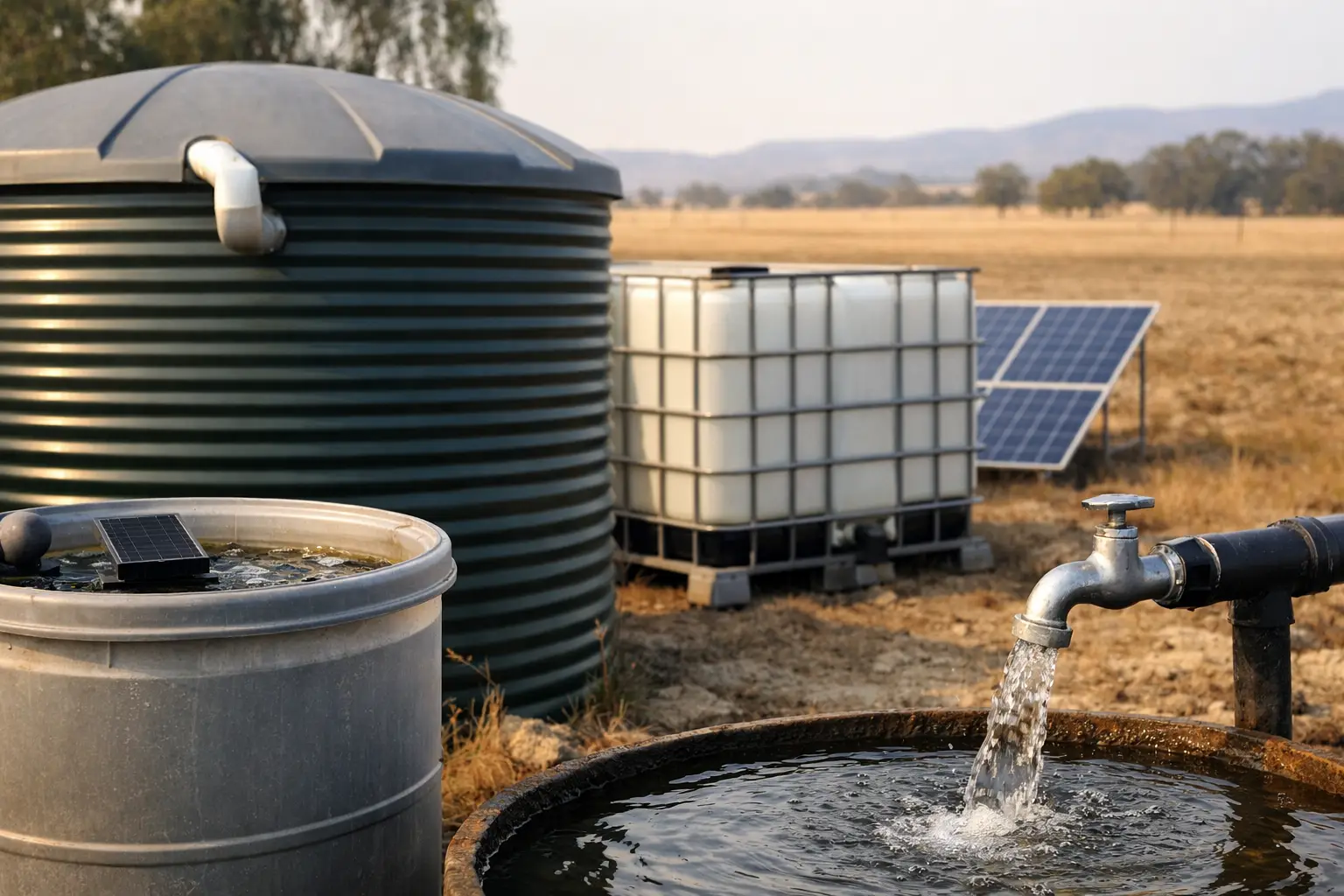
A full tank after a decent downpour is reassuring. A tank that is too small, poorly sited or unable to deliver water at the tap is far less useful when dry weather settles in. Good water storage is not simply about buying the biggest tank that fits – it is about building a system that suits your roof, household, property and intended use.
For an Australian home, acreage block, farm or commercial site, stored rainwater can support garden use, toilets, washing, livestock, fire preparedness and, with the right treatment, household drinking water. The right setup can reduce reliance on mains supply or give rural properties a dependable source when there is no town water connection. The details matter, particularly when the tank, pump and filtration equipment need to work together for years.
Start with how you will use the water storage
The first question is not, “Which tank looks best?” It is, “What needs to keep running when rain is scarce?” A family using rainwater for gardens and laundry has a different demand profile to a rural household relying on tank water for every tap. A farm may need a separate supply for stock, wash-down or irrigation, while a builder may need temporary or permanent storage sized around the site’s water needs.
Drinking water use generally calls for more planning than garden-only storage. Allow for daily household demand, the number of occupants and periods when rainfall is lower than expected. If the tank is intended to supply a whole house, factor in showers, toilets, washing machines and outdoor taps rather than estimating from drinking water alone.
It also pays to keep critical uses separate where possible. For example, a dedicated fire reserve or stock-water tank can protect capacity that might otherwise be used up by household demand. Whether this is necessary depends on your location, local planning conditions and the practical risks on your property.
Size the tank around rainfall, roof area and demand
A large roof can collect a surprising amount of water, but collection is only one side of the equation. Your tank must also be large enough to carry water through dry weeks or months. In many parts of Australia, rainfall arrives in uneven bursts. A small tank may overflow frequently in wet conditions yet run empty well before the next meaningful rainfall.
A useful starting point is to consider three figures: your roof catchment area, local rainfall pattern and expected water use. As a broad guide, one millimetre of rain falling on one square metre of roof produces about one litre of water before losses. First-flush diversion, gutter overflow, wind and evaporation all reduce the amount that reaches the tank, so it is sensible to allow a margin rather than planning around a perfect capture rate.
Tank capacity is also limited by access and site constraints. Measure the available footprint, including room for delivery, installation, plumbing and future maintenance. Check overhead clearances for gutters, eaves and powerlines. On tight suburban blocks, a slimline tank may make better use of a side passage. On an acreage or farm, a larger round tank is often the most economical way to store substantial volumes.
Choosing two tanks instead of one can be worthwhile in some situations. They can fit around access restrictions, provide backup if one tank needs maintenance, and make it easier to reserve water for a particular use. The trade-off is extra plumbing and potentially higher installation costs.
Round, slimline poly or Aquaplate steel?
Round poly tanks are a popular choice where space allows. Their shape is efficient for larger capacities, and UV-stabilised polyethylene construction is well suited to exposed Australian conditions. They are generally straightforward to position and are available in a wide range of colours and sizes.
Slimline poly tanks are designed for narrow spaces beside homes, sheds and commercial buildings. They offer useful capacity without taking over a courtyard or driveway edge, although their narrower footprint means they may not deliver the same volume as a large round tank.
Aquaplate steel tanks are often chosen for high-capacity installations and properties wanting the strength of a steel structure. BlueScope Aquaplate steel is engineered for water storage, with a polymer coating that helps protect against corrosion. Warranty terms vary by product and manufacturer, so always check the specific construction and anti-corrosion coverage before buying. A quality tank is a long-term investment, not a short-term garden accessory.
The base is part of the water system
Tanks need a level, stable and fully supported base. Water is heavy – one litre weighs about one kilogram – so even a modestly sized tank places considerable load on the ground. An uneven base can stress the tank, fittings and pipework, and it may affect warranty requirements.
A prepared concrete slab is common for many installations. Compacted crusher dust or a properly constructed gravel base may also be suitable for certain tanks and sites. The best option depends on the tank manufacturer’s requirements, ground conditions, slope and access. Follow the supplied installation guidance rather than assuming an existing paved area is adequate.
Think through drainage at the same time. Water should not pond around the tank base or flow back towards the house. On sloping blocks, professional advice may be needed to manage retaining, drainage and safe access for delivery equipment.
A tank needs the right pump to be useful
Gravity can supply water where there is enough fall, but most homes need a pump to provide practical pressure at taps, showers and appliances. The pump should be matched to the job, not chosen only on price or maximum flow figures.
For household use, consider how many outlets may run at once and how far the pump needs to push water. A pressure pump sized for a small garden may struggle when a shower, washing machine and toilet are operating together. Conversely, an oversized pump can cycle unnecessarily and add noise, energy use and wear.
Rain-to-mains pumps are designed for homes that use rainwater when it is available and can switch to mains water when the tank is low. They are useful in many suburban installations, but the plumbing arrangement must meet applicable requirements. Backflow prevention and air gaps are not optional details – they protect the drinking water supply.
Farm and irrigation duties may require higher flow or greater pressure, particularly over long pipe runs. Fire pumps should be selected around the expected emergency application, hose fittings, water source and local fire planning requirements. A submersible pump can be a practical option where noise reduction, weather protection or a specific tank arrangement makes an external pump less suitable.
Protect the pump with an appropriate inlet strainer and install isolation valves so routine service is easier. A pump that is accessible, protected from weather and correctly plumbed is more likely to provide dependable service when you need it.
Protect water quality from the roof to the tap
Clean water starts before it reaches the tank. Keep gutters clear of leaves and debris, fit quality leaf screening, and ensure the inlet is designed to reduce disturbance of sediment. A first-flush device can divert the initial roof runoff, which may contain dust, bird droppings and other contaminants collected between rain events.
For water used on gardens or for general outdoor cleaning, basic screening may be enough. For household supply, filtration should be selected according to the intended use and water quality. Sediment cartridges remove fine particles, while carbon filtration can improve taste and reduce some odours and contaminants. UV systems can provide an additional disinfection barrier when correctly sized, installed and maintained.
No filter is fit-and-forget. Cartridges need replacement, UV lamps have a service life, and housings should be checked for leaks and pressure loss. If your household relies on rainwater for drinking, a planned maintenance routine is one of the simplest ways to protect the system and your family.
Allow for approvals, delivery and future maintenance
Before ordering, check council requirements, building rules and any conditions that apply to new homes, bushfire-prone land, stormwater management or commercial sites. Requirements differ between states, councils and developments. A licensed plumber can help ensure the connection to household plumbing is compliant.
Delivery access deserves early attention. Confirm the route from the road to the final tank position, including gates, turning space, soft ground, steep driveways and overhead obstacles. Larger tanks can be excellent value per litre, but only if they can be delivered and safely positioned on site.
It is also worth choosing fittings and accessories with servicing in mind. Leave room to inspect screens, clean strainers, reach valves and replace filters. At Aus Water Tanks, the practical aim is to help customers choose compatible storage, pumping and filtration equipment rather than leaving them to piece together a system after the tank has arrived.
The most reliable water setup is the one planned for ordinary days as well as dry spells: enough stored volume, a sound base, sensible plumbing and equipment you can maintain. Start with your real water needs, then choose components that will keep delivering long after the next rain has passed.