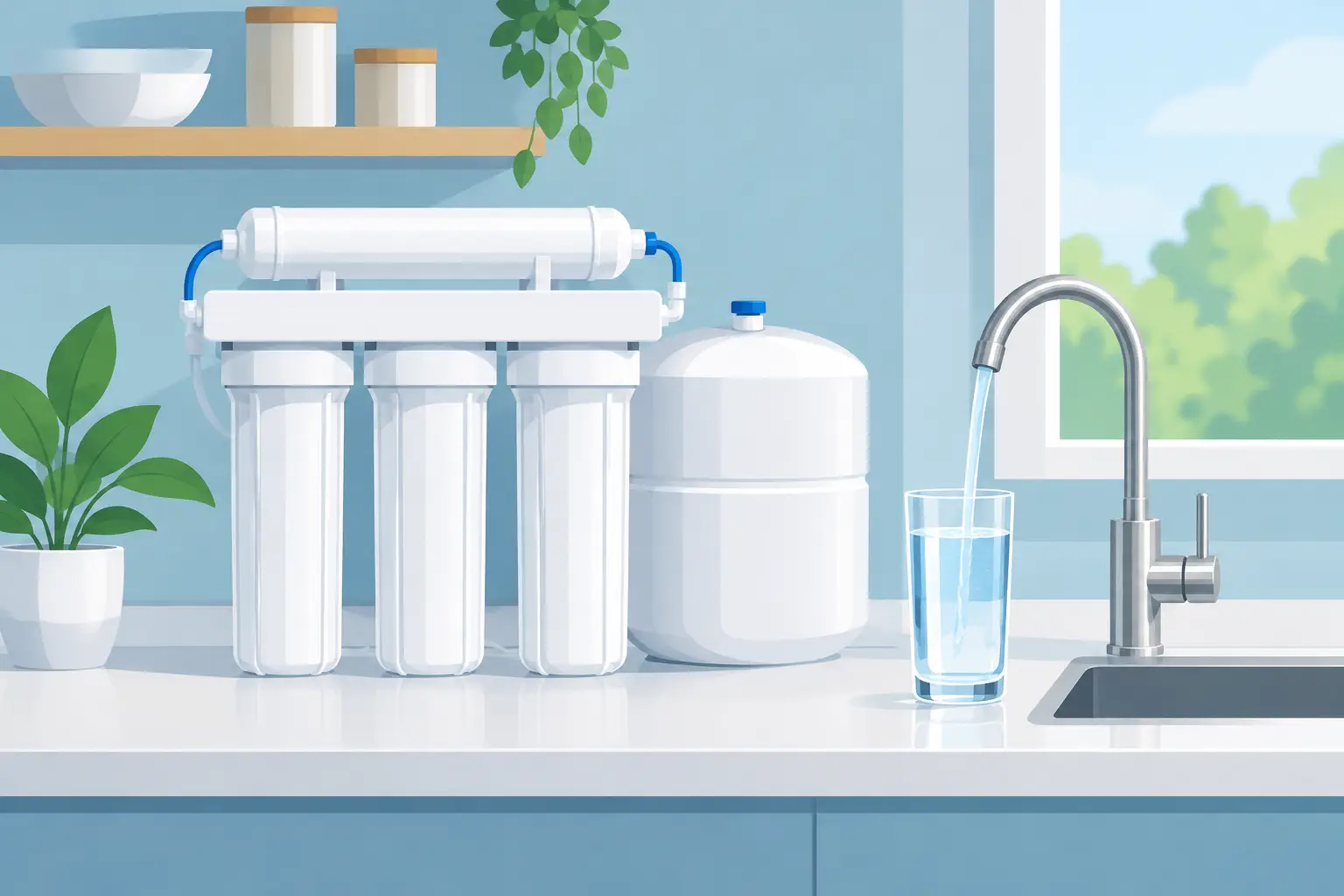
A glass of water can look perfectly clear and still carry a taste, smell or dissolved impurities you would rather not drink. That is why reverse osmosis is a popular option for households that want a higher level of treatment at the kitchen tap, particularly for drinking water, cooking and baby formula.
It is not a one-size-fits-all answer to every water problem. Reverse osmosis systems are designed for a specific job: reducing a broad range of dissolved contaminants from a smaller volume of water. Understanding where they fit alongside sediment filtration, carbon filtration and UV disinfection makes it much easier to choose a system that delivers real value.
What reverse osmosis does
Reverse osmosis, often called RO, uses mains water pressure to push water through a very fine semi-permeable membrane. The membrane allows water molecules to pass while holding back many dissolved substances. Treated water is stored in a small pressure tank and delivered through a separate drinking-water tap.
A typical under-sink system uses several stages. A sediment pre-filter catches fine grit and particles that could damage the membrane. Carbon pre-filters help reduce chlorine, taste and odour compounds. This matters because chlorine can shorten the life of many RO membranes. The membrane then performs the fine filtration, while a final carbon filter polishes the taste before the water reaches the tap.
Depending on the water source, membrane specification and condition, an RO system can reduce dissolved salts, many heavy metals, fluoride, nitrates and a range of other dissolved contaminants. It can also substantially lower total dissolved solids, or TDS. No filtration system should be chosen on a general claim alone, though. If there is a particular concern, such as bore water salinity, lead from older plumbing or a local water-quality issue, water testing and the system’s performance data should guide the decision.
Why households choose reverse osmosis
For many families on town water, the immediate difference is taste. Carbon filtration handles much of the chlorine taste and smell, while the RO membrane further reduces dissolved material that can leave water tasting mineral-heavy or slightly bitter. Tea, coffee and cooking water can taste cleaner as a result.
RO can also be worthwhile where a household wants a dedicated supply for drinking and food preparation without filtering every litre used in showers, toilets, washing machines and the garden. A point-of-use system sits beneath the kitchen sink, so it is generally a more economical approach than trying to achieve RO-quality water across the whole house.
For rainwater households, reverse osmosis may suit people seeking an additional polishing stage for drinking water. Rainwater quality can vary with the roof material, gutter maintenance, bird activity, storage conditions and local environment. However, RO is not a replacement for sensible rainwater management. A clean roof catchment, covered tank, first-flush diversion where appropriate, sediment filtration and correctly sized UV disinfection remain the foundations of a safe whole-house rainwater setup.
Reverse osmosis is not the same as whole-house filtration
This is the point that often saves households from buying the wrong equipment. Whole-house filtration protects water quality throughout the home and protects appliances, taps and plumbing from sediment. For rainwater, a properly selected whole-house system can combine sediment cartridges, carbon media where needed and UV disinfection to manage particles, tastes, odours and microorganisms.
For town water, whole-house sediment and carbon filtration is commonly used to reduce sediment, chlorine, chloramines, taste and odour. It treats water at the point where it enters the home, so the benefits extend to showers, laundry and kitchen use.
An RO unit has a different role. It is normally installed at one point of use, most often the kitchen sink, to provide highly treated water for drinking and cooking. In many homes, the best arrangement is not an either-or choice: whole-house filtration improves the water supplied around the property, while reverse osmosis provides an extra level of treatment at the drinking tap.
The trade-offs to consider before buying
RO systems produce a concentrate stream as the membrane separates dissolved material from the treated water. In practical terms, some incoming water is sent to drain during production. The amount varies with water pressure, membrane type, water temperature and the system design. This is worth considering in areas where water use is closely managed, or where a home relies solely on stored rainwater.
Water pressure also matters. Low inlet pressure can reduce production and affect performance. Some installations need a compatible booster pump, particularly where pressure is inconsistent. If you are on tank water with a pressure pump, check both the available pressure and the way the RO unit will be supplied before ordering.
RO-treated water is lower in dissolved minerals, which many people prefer for its clean taste. Others find it tastes too light. A remineralisation cartridge can be added after the membrane in suitable systems to adjust the taste and add back small amounts of selected minerals. This is a preference decision, not a mandatory step for every installation.
Space under the sink is another practical consideration. Most systems need room for the filter housings, membrane, storage tank, tubing and a separate tap. Measure the cupboard, check access for future cartridge changes and consider where the drain connection will be made. A tidy installation is easier to service and less likely to be ignored when maintenance is due.
Choosing the right system for your water source
Start with the water you actually have, rather than the system that sounds most comprehensive. Town water users may want RO primarily for improved drinking-water taste and an extra reduction of dissolved contaminants. A quality carbon pre-treatment stage is particularly useful where chlorine or chloramines are present.
Rainwater users should first make sure their whole-house treatment train is appropriate. Sediment filters manage dirt and fine particles. Activated carbon can improve taste and odour where required. UV disinfection addresses microbiological risks, but only works reliably when the water is clear enough for UV light to pass through. An RO unit can then be considered as a dedicated kitchen drinking-water upgrade.
Bore or other private water supplies need more investigation. High TDS, hardness, iron, manganese, sulphur smells and microbiological contamination each require different treatment approaches. An RO membrane may be part of the solution, but untreated iron, hardness or sediment can foul it quickly. Pre-treatment is not an optional extra in these situations – it is what helps the membrane perform and last.
Look beyond the number of stages
A higher stage count does not automatically mean a better system. What matters is the purpose of each stage, the quality and size of the cartridges, membrane capacity, replacement availability and whether the system suits your feed water. Standard-sized replacement cartridges can make future servicing simpler and more cost-effective.
Check what is included as well. A complete under-sink package should clearly identify the filters, membrane, storage tank, tap, tubing and fittings. If you are replacing an older system, confirm dimensions, connection sizes and whether the new membrane housing is compatible with your available space.
Maintenance keeps water quality on track
An RO system is not fit-and-forget. Pre-filters are usually changed more often than the membrane because they protect the system from sediment and chlorine. The final carbon filter also needs replacement to maintain fresh taste. Membrane life depends heavily on feed-water quality, usage and timely pre-filter changes.
Follow the replacement intervals recommended for your system and adjust them if water conditions or household demand call for it. A noticeable drop in flow, a change in taste or a rising TDS reading can indicate that servicing is due, but waiting for those signs is not the best maintenance plan.
Sanitising the system during scheduled service is also good practice, especially after a long period of low use. Use compatible replacement cartridges and membranes, and make sure fittings are properly seated before turning the water back on. If you are uncertain about the installation or plumbing connections, a licensed plumber can provide peace of mind.
A practical upgrade for the water you drink most
Reverse osmosis earns its place when your priority is cleaner-tasting, highly treated drinking water at a single tap. It works best as part of a considered treatment plan, not as a shortcut around poor tank hygiene, unsuitable pre-filtration or an untested private water supply.
For households comparing options, begin with the source water, the concern you want to address and the amount of water you need to treat. A well-matched system is easier to maintain, better value over time and gives your family confidence each time they fill a glass.