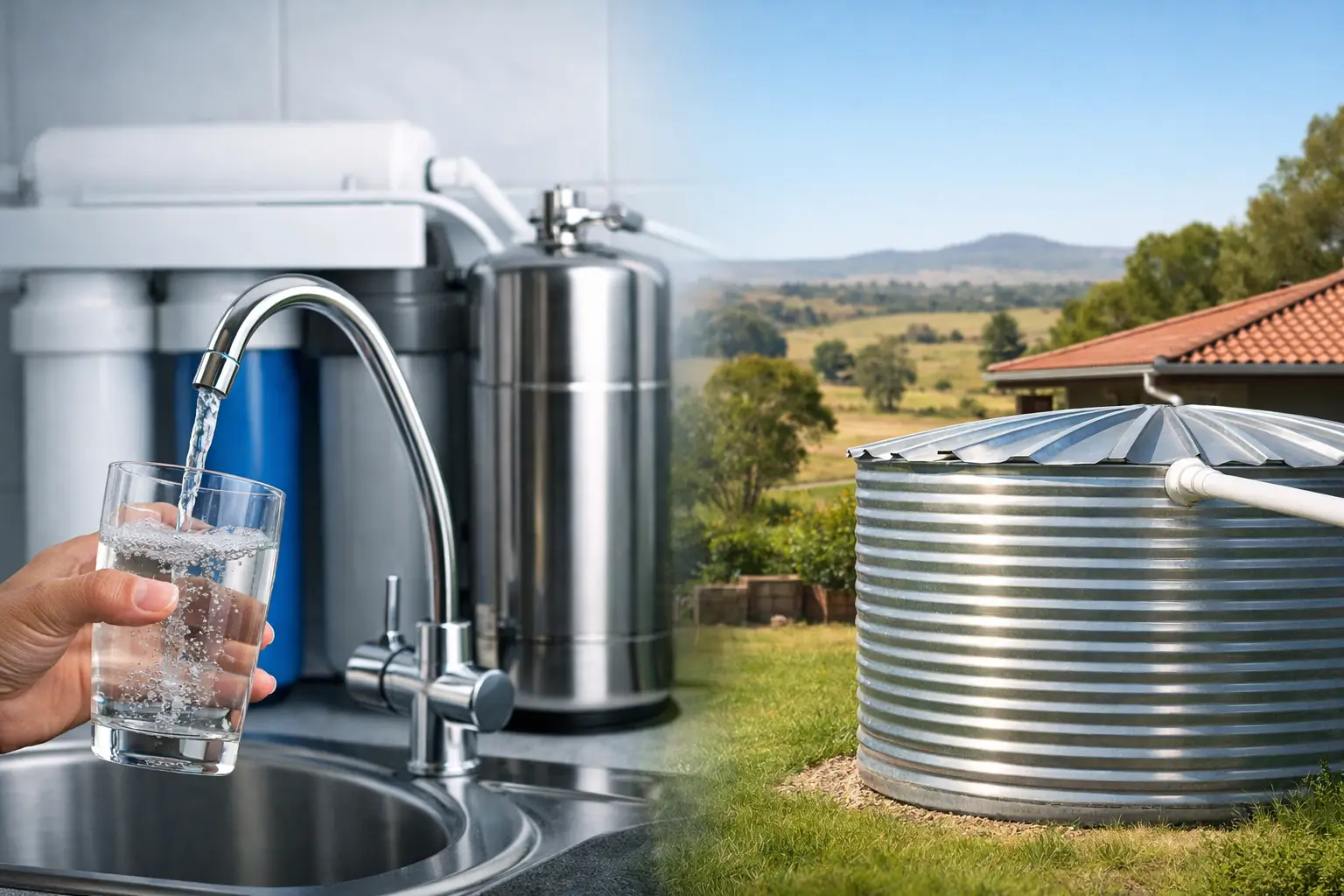
A rainwater tank can provide excellent household water, particularly when the catchment, tank and plumbing are well maintained. But water filtration is the step that helps turn stored water into a dependable supply for drinking, cooking, washing and everyday use. The right system removes the contaminants most likely to affect your water, without adding unnecessary cost or restricting pressure around the home.
For Australian households, acreage properties and rural sites, the best approach is rarely a single filter chosen in isolation. Your roof material, surrounding trees, tank condition, water use, pump size and local water quality all play a part. A practical filtration setup starts by identifying what is in the water, where it enters the system and how much water your household needs at peak demand.
What water filtration is designed to remove
Rainwater starts out relatively clean, but it collects material as it runs across the roof and through gutters. Leaves, dust, bird droppings, insects, airborne pollution and fine roof sediment can all make their way towards the tank. Once stored, fine particles can settle on the tank floor, while organic matter may affect taste, odour and water clarity.
Water filtration is not one job. Different filter media address different concerns. Sediment filtration captures physical particles, carbon filtration improves taste and odour, and ultraviolet treatment disinfects water by inactivating microorganisms. Each has a purpose, and each works best when installed in the right order.
For a tank supplying toilets, laundry and garden taps only, basic pre-filtration may be enough. For water used at kitchen taps, bathrooms and throughout a whole house, a more complete system is usually the sensible choice. This is especially true where young children, older family members or visitors rely on the supply.
Start with protection before the tank
The most cost-effective filter is often the one you do not need to replace because debris was stopped earlier. Good catchment protection reduces the load on every component downstream.
Fit gutter guards where suitable, keep gutters clear, and use a leaf strainer or rain head before the tank inlet. A first-flush diverter can also help by sending the first, dirtiest roof runoff away from the tank after a dry spell. This is particularly useful in dusty rural areas, near busy roads, or beneath overhanging trees.
Your tank should have a secure lid, screened openings and mosquito-proof mesh. The overflow needs screening too. These simple measures help prevent insects, vermin and leaves entering the stored supply. They also make ongoing water filtration easier, as cartridges are not forced to deal with larger debris that should have been excluded at the start.
The usual order for whole-house water filtration
A whole-house system commonly begins with a sediment cartridge. This filter catches grit, rust, sand and suspended particles before they reach finer filters, UV equipment, appliances and taps. It can also protect pump seals and valves from unnecessary wear.
Sediment cartridges are available in different micron ratings. A lower micron rating captures finer material, but it can block sooner where tank water contains a lot of sediment. A higher rating offers less fine filtration but may maintain stronger flow and need less frequent replacement. There is no single best rating for every property. Water that looks clear may suit a finer filter, while a tank with visible sediment may need staged filtration or more frequent servicing.
Carbon filtration generally follows sediment filtration. Activated carbon can reduce unpleasant tastes and odours caused by organic material, and it may improve the general quality of water at household taps. However, carbon is not a substitute for disinfection. It treats aesthetic water quality issues rather than reliably dealing with microbial risks.
UV treatment is often the final stage for potable rainwater systems. A UV chamber exposes water to ultraviolet light as it passes through, inactivating bacteria and other microorganisms when correctly sized, installed and maintained. UV is highly effective when the water is clear enough for the light to penetrate. That is why sediment filtration before the UV unit is essential.
Why filter placement matters
For a full-house rainwater supply, filters and UV equipment are usually installed after the pump, on the pressurised line leading to the house. This provides treated water at the taps while allowing the tank to hold bulk water efficiently. A correctly selected pressure pump supports steady flow through the system, even when more than one tap or appliance is operating.
Some properties use rainwater for selected fixtures and mains water for others. In these cases, the filtration layout must match the plumbing arrangement and any rain-to-mains changeover system. A licensed plumber can ensure the installation meets local requirements and avoids cross-connections between water supplies.
Choosing a system for your property
The right system depends on your water source and intended use. A suburban household collecting rainwater from a clean metal roof may need a different setup from a farm drawing from a dam, bore or mixed source. Bore water, for example, may contain dissolved minerals that standard sediment, carbon and UV filters do not remove. Water testing is worthwhile when there are concerns about salinity, iron, hardness, staining, unusual smells or persistent discolouration.
Consider household demand as well. A compact under-sink filter may suit drinking water at one kitchen tap, but it will not protect showers, washing machines or the rest of the home. A whole-house filter system needs sufficient flow capacity to avoid noticeable pressure loss at busy times, such as when someone is showering while the washing machine is filling.
When comparing filtration equipment, look beyond the initial purchase price. Check the housing size, cartridge availability, replacement cost, service access and rated flow. Larger cartridge housings often provide longer service intervals and better flow for family homes, although they take up more wall space. A system that is easy to access and service is more likely to be maintained properly.
Maintenance keeps filtered water dependable
No filtration system is fit-and-forget. Cartridges collect material and eventually restrict flow. UV lamps lose output over time, even when they still appear to be operating. Sediment can also build up in tanks, particularly where roof runoff protection is limited.
Replacement timing depends on water quality and usage. A cartridge may need changing earlier if pressure drops, water becomes cloudy, or there has been a heavy storm that has washed extra material from the roof. UV lamps are commonly replaced annually according to the manufacturer’s instructions, and the quartz sleeve should be checked and cleaned during servicing.
It is wise to keep a spare cartridge or service kit on hand, particularly for rural or remote properties where replacement parts may not be available locally at short notice. Record service dates on the filter housing or in a household maintenance diary. This small routine helps prevent a system being overlooked until flow has already dropped.
Tank maintenance matters too. Inspect screens, gutters and first-flush devices regularly. If there is a heavy layer of sediment in the tank, consider professional cleaning before it begins to affect the household supply. A clean tank reduces strain on filters and helps maintain better water quality all year round.
Common mistakes to avoid
The most common mistake is expecting one cartridge to solve every water-quality issue. A sediment filter cannot disinfect water, while UV treatment cannot remove mud or improve a strong earthy taste. Another issue is fitting a very fine cartridge without allowing for household flow rate. The water may be well filtered but frustratingly slow at the shower or kitchen sink.
It is also easy to overlook the pump. If the pump is undersized, poorly matched to the filtration system or set up with incorrect pressure settings, the entire system can feel unreliable. Pumps, tanks and filters should be selected as connected parts of one water supply system, rather than purchased separately without checking compatibility.
For homeowners who want straightforward advice on a complete rainwater setup, Aus Water Tanks can help match filtration, storage and pumping equipment to the property’s needs. The aim is a system that is practical to install, simple to service and built for dependable long-term use.
Clean water does not come from a filter alone. It comes from a well-managed catchment, protected tank, suitable pump and filtration system that suits how your household actually uses water. Start with the water you have, plan for the demands you place on it, and choose equipment you can maintain with confidence.