Borewater can look perfectly clear in a kitchen glass yet leave orange marks in the shower, a metallic taste in tea and scale inside hot-water appliances. That is why the best filters for borewater homes are not simply the biggest systems or the ones with the finest cartridge. They are systems selected around the actual water quality at your property.
For rural homes, acreage blocks and properties beyond town water, a bore can provide dependable supply through dry periods. But borewater chemistry varies widely, sometimes between neighbouring properties. A practical filtration system protects pumps, plumbing and household fixtures first, then treats water for its intended use – whether that is washing, stock, garden irrigation, toilets or drinking.
Start with a borewater test, not a filter catalogue
The right filter starts with a current laboratory water test. Borewater commonly carries fine sand and silt, iron, manganese, hardness minerals, dissolved salts or microbial contamination. It may also have low pH, which can contribute to corrosion in pipes and fittings. No single filter is designed to solve every one of these issues well.
Ask for testing that suits how the water will be used. For household supply, this generally means checking pH, hardness, iron, manganese, turbidity, total dissolved solids, salinity indicators and microbiological quality. Depending on your location and local history, testing for nitrates and other naturally occurring or land-use-related contaminants may also be sensible.
A result taken years ago is a useful reference, not a permanent answer. Water quality can shift with rainfall, drought, drawdown, nearby land activity and changes to the bore itself. Testing before choosing equipment can save a great deal of money on cartridges, media and systems that do not address the real problem.
The best filters for borewater homes work in stages
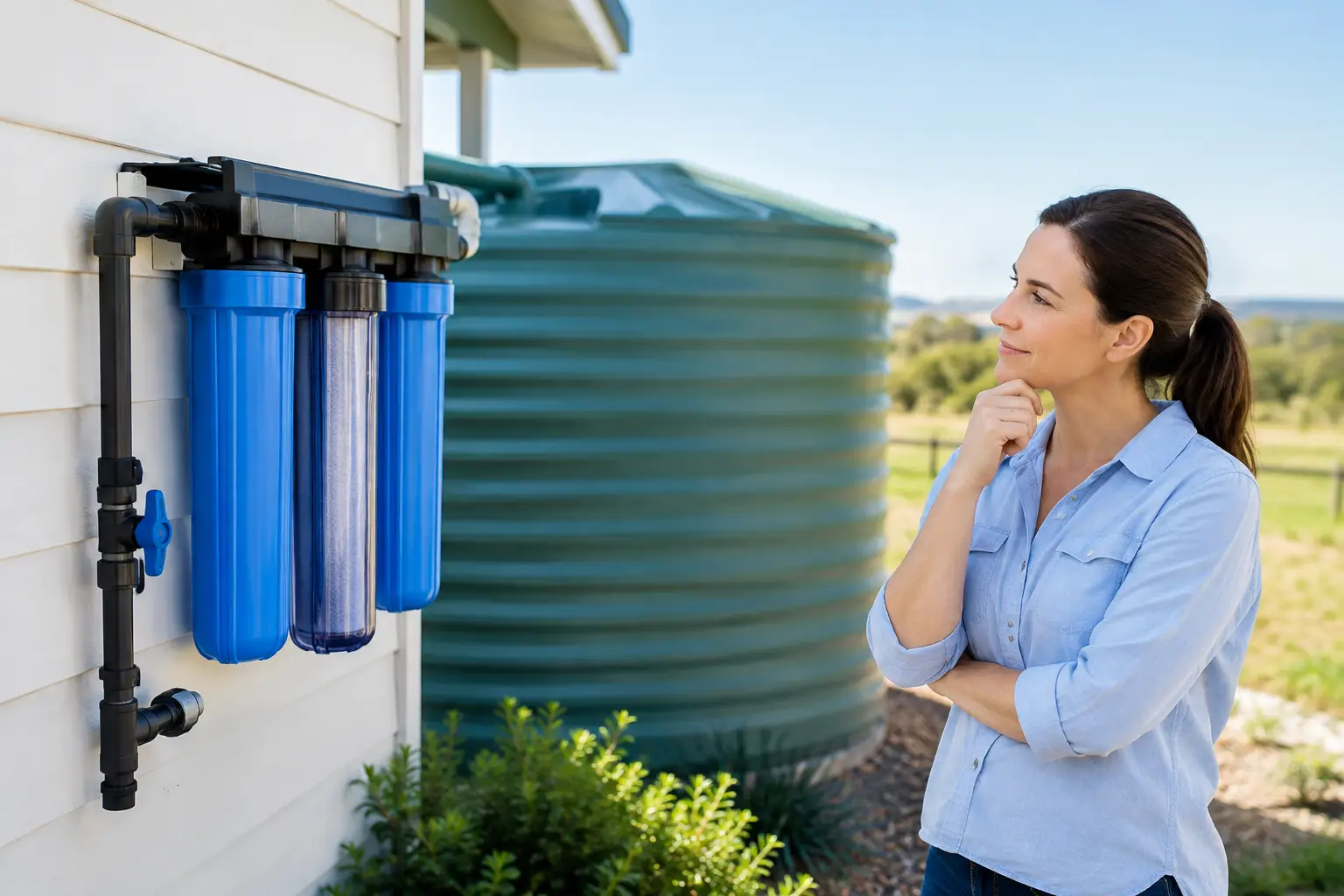
Whole-house borewater treatment is usually a sequence rather than one product. Each stage has a specific job, and getting the order right helps the following equipment work properly and last longer. A common setup may include the following components:
- A washable sediment filter or larger screen filter to catch grit, sand and heavier particles.
- A cartridge sediment filter to reduce finer suspended material and protect treatment equipment.
- A media filter sized for iron, manganese, hardness or acidity, based on the test result.
- A UV disinfection unit where microbiological treatment is required for household or drinking supply.
Not every property needs all four stages. A bore with only coarse sediment may need straightforward pre-filtration. Another may need specialised media treatment before UV can be effective. The aim is to build a system that suits your bore, your flow rate and the water demand of the household.
Sediment filters: the first line of protection
Sediment is one of the most common borewater problems, especially where a bore produces fine sand, clay or rusty particles. It can block taps, wear pump components and quickly foul finer filters. A washable, reusable filter is often a sensible first stage where sediment loads are high, because it can be cleaned rather than continually replaced.
Cartridge filters are useful for polishing water after the larger material has been removed. Their micron rating matters, but smaller is not always better. A very fine cartridge can restrict flow and block quickly if it is installed before a suitable coarse pre-filter. For a family home with several bathrooms, choose housings and cartridges that can meet peak demand without an excessive pressure drop.
Iron and manganese filters: for staining and metallic water
Orange, brown or black staining around toilets, basins and laundry fixtures is often associated with iron or manganese. These minerals can also build up in hot-water systems and leave unpleasant taste or odour. Standard sediment cartridges may catch some oxidised particles, but they will not reliably remove dissolved iron or manganese.
Media filtration is usually the more appropriate answer. Depending on the water chemistry, this may involve aeration, oxidation or a purpose-selected media tank that converts dissolved minerals into particles that can be filtered out. Some systems need periodic backwashing, which means they require adequate flow, drainage and a suitable control valve.
This is an area where water testing and correct sizing matter most. Iron treatment that is undersized can struggle during busy periods, while an unsuitable media can clog or fail to treat the particular form of iron present in the borewater.
Water softeners: for scale and hard water
Hard borewater contains calcium and magnesium. It is not always visibly dirty, but it can leave white scale on shower screens, kettles, taps and tiles. Over time, scale can reduce the efficiency and service life of hot-water systems, washing machines and other appliances.
A water softener uses ion-exchange resin to reduce hardness minerals. It needs salt for regeneration and a discharge point for the regeneration water, so it is a practical decision as much as a water-quality decision. Some homeowners choose to soften the whole house; others protect hot-water equipment and key internal outlets only.
Softening does not make microbiologically unsafe water safe, and it does not remove salinity in the same way as reverse osmosis. It solves a specific problem: scale caused by hard water.
UV systems: for microbiological protection
UV filtration is a strong option when test results or risk assessment show a need for microbiological treatment. It exposes water to ultraviolet light to inactivate microorganisms without adding chemicals to the water. For homes using borewater for drinking, food preparation and bathing, it can be an important final treatment stage.
However, UV is not a substitute for filtration. Cloudy water, sediment and iron can shield microorganisms from the UV light or coat the lamp sleeve, reducing performance. That is why a UV unit should be fitted after effective sediment and, where required, iron treatment.
UV lamps and sleeves require routine servicing. Keeping a service schedule is part of owning a dependable water system, just as checking a pump pressure switch or cleaning a tank screen is. Choose a unit rated for your expected flow, not just the smallest unit that fits in the shed.
What about reverse osmosis for borewater?
Reverse osmosis, often called RO, is generally best used as a point-of-use drinking water system under the kitchen sink. It can reduce many dissolved substances that other household filters do not address, including salts and certain minerals. This makes it useful where borewater is acceptable for general household use but has an unpleasant taste or high dissolved solids at the drinking tap.
Whole-house RO systems are more complex and expensive. They produce a reject stream, need careful pretreatment and may require storage and pumping arrangements. For most homes, it is more cost-effective to treat the full supply for sediment, staining and hygiene, then use RO only for drinking and cooking water if testing supports that approach.
Size the system for your home and bore, not just the pipework
A filtration system has to keep up with the household. Consider the number of people in the home, bathrooms, outdoor taps, stock or irrigation connections, and whether water is also supplied to a granny flat or shed. A filter that performs well at a low flow can become frustrating when someone showers while the washing machine is filling.
Your pump and pressure system also affect filter performance. Every filter creates some resistance, particularly as it collects material. A correctly matched pressure pump, suitable pipe sizing and generously sized filter housings help maintain usable flow. If you are adding a backwashing media filter, confirm that the pump can provide the flow needed for a proper backwash cycle.
Installation location matters too. Equipment should be protected from direct weather, accessible for cartridge changes and positioned with safe drainage for flushing or backwashing. In frost-prone areas, take steps to protect exposed pipework and housings.
Plan for filter servicing from day one
The ongoing cost of a borewater system is not limited to the original purchase. Cartridges need changing, washable screens need cleaning, media filters need backwashing, UV lamps need replacement and water quality should be retested periodically. The interval depends on the bore and household demand, not just the date marked on a box.
A falling flow rate, new staining, changes in taste or odour, cloudy water and unusually frequent cartridge changes are all signs that the system needs attention. Keeping spare cartridges and service parts on hand is worthwhile for remote properties, particularly when delivery times can be longer after wet weather or during busy rural periods.
Aus Water Tanks can help homeowners match whole-house filtration, UV equipment, replacement consumables and compatible pumping equipment to a planned water system. A water test and a clear picture of your household demand make that advice far more useful.
Borewater is one of the great advantages of living beyond the mains, but it deserves treatment as a working household supply rather than an afterthought. Test it, treat the issues it actually has and choose serviceable equipment that will keep delivering clean, reliable water long after installation day.