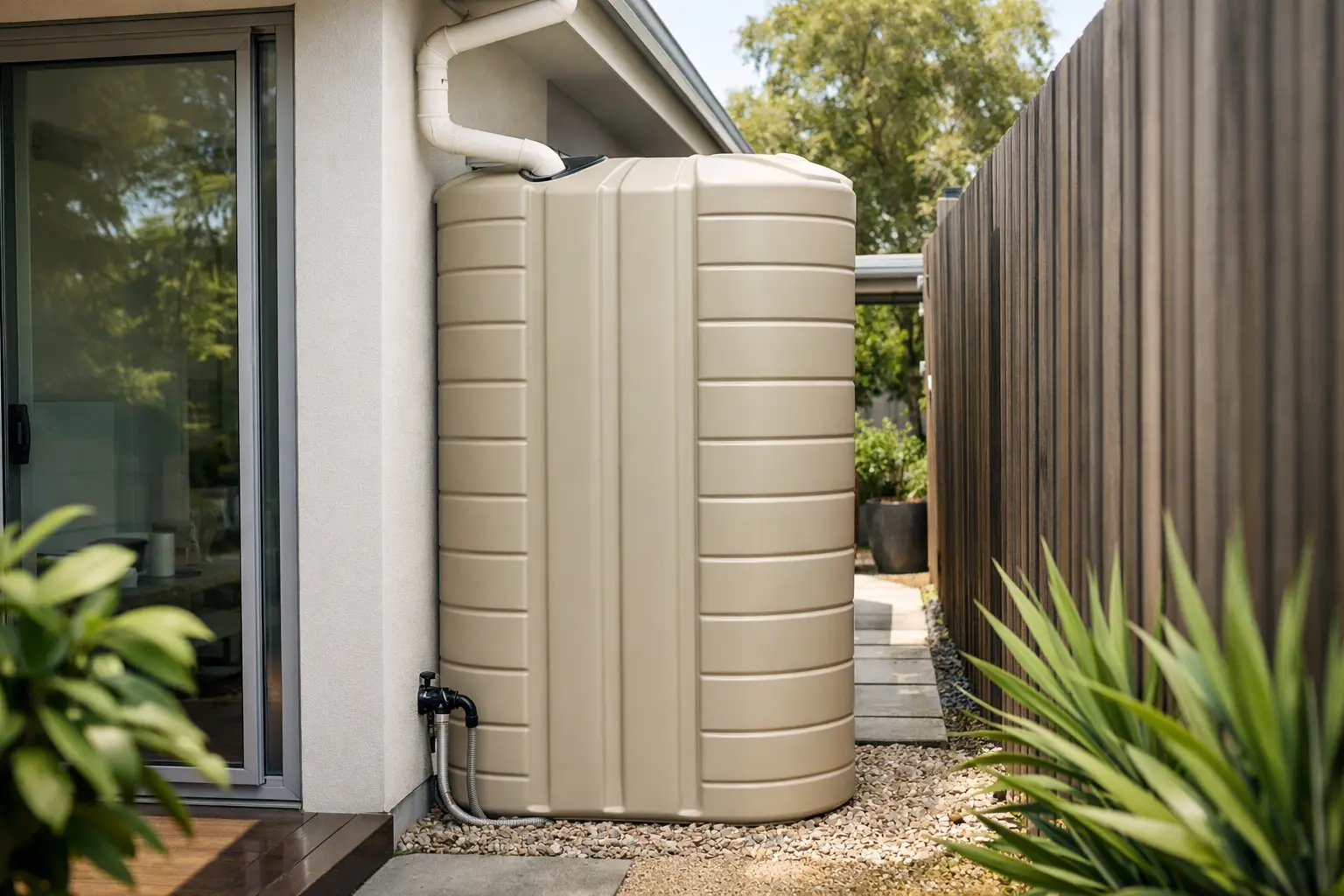
A narrow side passage should not rule out meaningful rainwater storage. Slimline poly rainwater tanks are built for the spaces where a round tank simply will not fit – beside a house, along a fence line, behind a garage or near a shed. For Australian homes dealing with water restrictions, rising bills or a desire for greater self-sufficiency, that makes them a practical option rather than a compromise.
Their tall, narrow footprint lets you collect water from a useful section of roof without taking over the backyard. The right tank can supply garden taps, toilets and washing machines, and can form part of a more complete rainwater system when matched with suitable pumping, filtration and plumbing.
Are Slimline Poly Rainwater Tanks Right for Your Property?
Slimline tanks are usually best suited to suburban blocks, townhouses, new builds and properties with limited clearance around the home. They can also work well on acreage properties where a smaller tank is needed close to a dwelling, workshop or stable, while larger storage sits elsewhere.
The main advantage is the footprint. A slimline tank uses length and height rather than diameter to deliver capacity, so it can sit neatly in an area that might otherwise go unused. Access paths, laundry walls and boundary-side spaces are common locations, provided there is enough room to install, inspect and maintain the tank.
The trade-off is capacity. A round tank generally stores more litres for the area it occupies, particularly once you move into larger rural or farm-scale storage. If you have a generous backyard and need water for livestock, irrigation or household supply, a round poly or steel tank may offer better value per litre. Slimline models are about making a restricted site work well, not about chasing the highest possible capacity.
Before choosing a tank shape, measure more than the empty space. Check the available length, width and height, including eaves, downpipes, gates, air-conditioning units and any overhangs. Allow room for inlet screening, outlet fittings and access to the lid. It is also worth considering whether a tank can be safely delivered and moved into position. A tank that fits on paper is not much use if a narrow gate or tight turn prevents installation.
Choosing the Right Slimline Tank Capacity
Capacity should be based on your roof catchment, local rainfall and how you intend to use the water. A small tank connected to one downpipe can make a noticeable difference to garden watering. A larger slimline tank connected to a substantial roof area may support toilet flushing, laundry use and regular outdoor demand.
Start by looking at the roof section feeding the tank. A large roof can harvest a surprising volume during a decent storm, but the tank can only hold what its capacity allows. On the other hand, an oversized tank attached to a small roof section may take a long time to refill. The aim is to balance collection area, storage and expected water use.
For a garden-only system, think about the months when you need water most. In many parts of Australia, gardens demand more through dry periods, just when rainfall may be less reliable. A bigger tank provides a better buffer, but only if there is enough roof catchment to keep it topped up across the year.
For household connections, calculate daily demand carefully. Toilets and washing machines can use significant water over a week, particularly in a busy family home. A licensed plumber can help assess the plumbing arrangement and local requirements, including whether a rain-to-mains system is appropriate for your property.
It also pays to consider future needs. If you are landscaping, adding a granny flat, building a shed or planning to connect additional fixtures later, choose a tank location and system layout that leave options open. Linking tanks can be useful, although it requires sensible positioning and correctly sized connecting pipework.
Poly Construction for Australian Conditions
Quality poly tanks are a popular choice because they are comparatively lightweight, easy to handle and designed to cope with outdoor exposure. Australian-made tanks commonly use UV-stabilised polyethylene to help withstand harsh sunlight, while their one-piece moulded construction avoids the seams found in some other tank types.
Colour matters more than appearance. Darker tank colours can help reduce light penetration, which is useful for limiting algae growth. Choose a colour that suits your property, but make sure it is available from a manufacturer with a proven track record and a clear construction warranty. For water intended for household use, confirm that the particular tank and fittings are suitable for potable water storage.
A slimline tank also needs adequate support. Water weighs one kilogram per litre, so even a modest tank becomes extremely heavy when full. The base must be level, fully supported and capable of carrying the tank’s filled weight without settling or twisting. A properly prepared concrete slab is often preferred, although other engineered bases may be suitable depending on the site and manufacturer instructions.
Do not place a tank on loose pavers, uneven soil or a few concrete pads. An unsupported section of the tank base can create stress over time and may affect warranty coverage. Good preparation is one of the most valuable parts of the whole installation.
Fittings, Overflow and Water Quality
A rainwater tank is only as dependable as the components around it. Water enters through gutters and downpipes, so keeping leaves, insects and roof debris out at the start will reduce cleaning later. Gutter guards can help in leafy areas, but they are not a replacement for regular gutter maintenance.
At the tank, fit suitable inlet screening and mosquito-proof protection. A first-flush diverter is worth considering, particularly where roofs collect dust, bird droppings or leaf litter between rain events. It diverts the initial, dirtier runoff before cleaner water flows into the tank.
Overflow needs just as much attention. During a heavy downpour, a full tank must discharge water safely away from buildings, neighbouring properties and tank foundations. Poor overflow drainage can lead to erosion, damp areas and nuisance water around the home. Your installer should plan the overflow route before the tank goes in, not after the first major storm.
If rainwater is used for drinking, cooking or bathing, filtration requirements depend on the water source, household needs and local health guidance. Sediment filtration, carbon filtration and UV treatment can each have a role, but no single setup suits every property. Water intended only for the garden has different needs from water supplying a whole home.
Pairing a Slimline Tank With the Right Pump
Gravity pressure from a slimline tank is usually not enough for a hose, irrigation system or internal household fixtures. A pressure pump provides usable flow and pressure, but it must suit the job. A basic garden pump may be ideal for taps and sprinklers, while a whole-house or rain-to-mains pump is designed for more demanding, automatic supply arrangements.
Pump selection comes down to required flow, pressure, pipe length, elevation and the number of outlets likely to run at once. Buying the biggest pump is not always the answer. An oversized pump can cycle unnecessarily, create noise and cost more than needed, while an undersized unit can leave showers, taps or sprinklers underperforming.
Protection components are part of a reliable system. A pump cover helps shield equipment from weather, and a suitable strainer can protect the pump from debris. Dry-run protection is valuable where tanks may run low, especially for homes relying heavily on stored water through a dry spell.
For a straightforward system, it helps to source the tank, pump, fittings and filtration equipment from a specialist that can check compatibility before you order. Aus Water Tanks can assist with practical product guidance and quotes for customers who want to build a complete rainwater solution without second-guessing every component.
Installation Checks That Prevent Costly Problems
Tank installations must comply with relevant local requirements, and plumbing connections should be completed by appropriately licensed trades. This is particularly important where rainwater is connected to internal fixtures, mains water backup or fire-fighting supply.
Before delivery day, confirm access from the street to the tank pad, including overhead wires, sharp corners and ground conditions. Have the base finished and cured where required, and ensure downpipe alterations, overflow drainage and plumbing work are scheduled in the right order. A little planning avoids paying for a return visit or having a tank sitting in the driveway.
Once installed, keep the lid closed, inspect screens after storms and clear leaves from gutters regularly. Check for leaks around fittings, confirm overflow water is draining correctly and service filters on schedule. These simple jobs protect water quality and help the system deliver value for years.
A well-chosen slimline tank can turn an overlooked strip beside the house into a dependable reserve of water. Measure carefully, match the tank to your roof and water use, and set it up properly from the beginning. That is how a compact tank earns its place long after the next dry spell arrives.