If you’re thinking about installing a rainwater tank, one of the first questions you’ll probably ask is: What size rainwater tank do I need?
The answer depends on more than just how much space you have in the backyard.
Your roof catchment area, local rainfall, household water usage, number of people in your home and what you plan to use the rainwater for can all influence the right tank size.
For rural and acreage properties, the calculation can be even more important, particularly when rainwater is being used for household supply, gardens, livestock or other applications.
In this guide, Aus Water Tanks looks at the key things to consider when choosing the right rainwater tank size for your property.
How Much Rainwater Can You Collect From Your Roof?
Your roof is essentially your rainwater collection area.
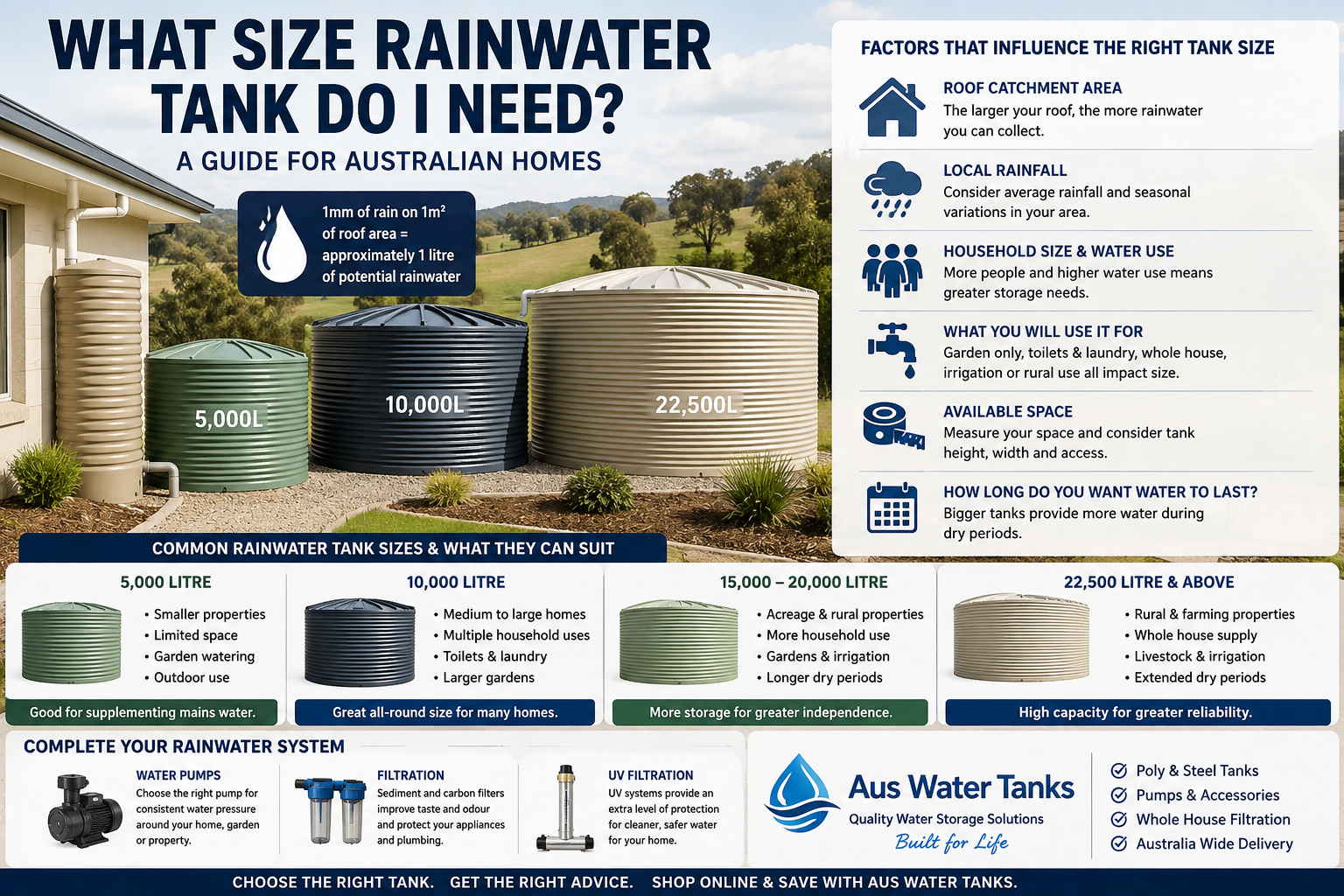
As a useful rule of thumb, 1mm of rainfall on 1 square metre of roof area represents approximately 1 litre of potential rainwater collection, before allowing for losses.
For example, if you have a roof catchment area of 200 square metres and receive 20mm of rain:
200m² × 20mm = approximately 4,000 litres of potential rainwater
In practice, the amount reaching your tank will be lower because of factors such as first-flush diversion, gutter overflow, evaporation and other system losses.
Still, this simple calculation gives you a good starting point for understanding just how much water your roof can potentially collect.
And sometimes the result is surprising — even a relatively modest roof can collect thousands of litres during a decent rainfall event.
What Will You Use Your Rainwater For?
Before choosing a tank, think carefully about how you intend to use the stored water.
Rainwater can potentially be used for:
- Watering gardens and lawns
- Outdoor taps
- Washing vehicles
- Toilet flushing
- Washing machines
- Irrigation
- Household water supply
- Rural and acreage applications
- Livestock and farm use, where appropriate
If you’re only collecting rainwater for occasional garden watering, your storage requirements may be very different from a household relying heavily on tank water.
The more jobs you expect your rainwater system to perform, the more important tank capacity becomes.
Is a 5,000 Litre Rainwater Tank Big Enough?
A 5,000L rainwater tank can be a practical option for properties with limited space or households wanting to supplement mains water.
It may be suitable for applications such as garden watering, outdoor cleaning or supplying selected household fixtures, depending on your rainfall and water consumption.
For suburban properties, space can sometimes be more important than maximum capacity.
This is where slimline poly rainwater tanks can be particularly useful, as they’re designed to fit into narrower spaces alongside houses, garages and boundaries.
What About a 10,000 Litre Rainwater Tank?
Moving up to a 10,000L water tank provides considerably more storage and can suit households wanting to make greater use of harvested rainwater.
A tank around this size may be considered for larger suburban blocks, semi-rural properties and households wanting rainwater for multiple applications.
But bigger isn’t automatically better.
If your roof catchment or local rainfall can’t regularly replenish a large tank, additional capacity may not provide as much benefit as expected. On the other hand, in areas with periods of heavy rainfall followed by long dry spells, additional storage can be extremely valuable.
Larger Rainwater Tanks for Rural and Acreage Properties
For rural properties and acreage, larger-capacity rainwater storage often becomes much more important.
Depending on the property and intended use, this might mean considering 15,000L, 20,000L, 22,500L or larger rainwater tanks.
Some properties may also benefit from installing multiple tanks and connecting them together.
When rainwater is an important part of your household or property’s water supply, it’s worth considering not only average rainfall but also how long you may need your stored water to last between significant rainfall events.
Poly Rainwater Tanks or Steel Rainwater Tanks?
Once you’ve considered capacity, the next question is often whether to choose a poly rainwater tank or steel rainwater tank.
Both can be excellent options.
Poly Rainwater Tanks
Poly water tanks are lightweight, durable and available in a wide range of shapes, capacities and colours.
They can be an excellent choice for suburban homes, acreage, rural properties and many commercial applications.
Options include traditional round tanks as well as slimline poly water tanks for properties where available space is limited.
Steel Rainwater Tanks
Steel rainwater tanks are another popular Australian water storage solution, particularly for larger-capacity applications.
Modern steel tanks are available in a range of sizes and finishes and can be well suited to homes, farms, rural properties and acreage.
The best choice ultimately depends on your required capacity, available space, property layout, budget and personal preference.
Don’t Forget Your Rainwater Tank Pump
Choosing the tank itself is only one part of building an effective rainwater system.
If you want to move water from your tank to household fixtures, gardens or irrigation, you’ll also need to consider the right rainwater tank pump.
Depending on the application, this could include:
- House water pumps
- Pressure pumps
- Submersible pumps
- Rainwater tank pumps
- Rains-to-mains systems
The correct pump depends on factors such as required water pressure, flow rate, number of outlets, pipework and how the water will be used.
Aus Water Tanks also has information available to help customers understand which water pump is right for their application.
What About Whole House Water Filtration?
If you’re planning to use rainwater inside your home, water quality and treatment should also be considered.
Depending on the source water and intended use, a treatment system may incorporate stages such as sediment filtration, carbon filtration and UV water treatment.
UV whole house water filtration systems use ultraviolet light as part of the water treatment process, while carbon filtration can help address characteristics such as taste and odour.
The appropriate filtration and treatment system depends on your water source, water quality and intended use.
So, What Size Rainwater Tank Should You Choose?
There’s no single tank size that’s right for every Australian property.
Before making your decision, consider:
- Your roof catchment area
- Average and seasonal rainfall in your location
- How much water your household uses
- What you intend to use your rainwater for
- Available space on the property
- How long you want stored water to last
- Whether you have mains water available as a backup
- Whether the tank is for a suburban, acreage, rural or commercial property
- Your pump and filtration requirements
Taking a whole-of-system approach can help you choose a tank that’s suited not only to your property, but also to the way you actually intend to use your rainwater.
Need Help Choosing the Right Rainwater Tank?
With more than 30 years of water tank industry experience, Aus Water Tanks can help you explore water storage solutions for suburban homes, acreage, farms and rural properties.
Our range includes poly rainwater tanks, steel rainwater tanks, slimline water tanks, rainwater tank pumps, rains-to-mains systems, whole house water filtration, UV water filtration and water tank accessories.
Whether you’re considering a compact tank for garden use or a large-capacity rainwater storage system for an acreage property, choosing the right combination of tank, pump and filtration can make all the difference.
Browse the range and shop online with Aus Water Tanks.